
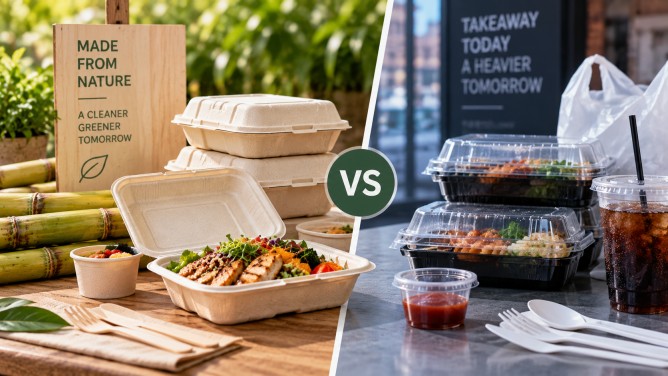
In the evolving landscape of food packaging, the choice between bagasse and plastic containers hinges on several critical factors, including menu type, holding time, sealing needs, regulatory environment, waste management infrastructure, and overall packaging costs. Bagasse, derived from sugarcane fiber, is increasingly favored for hot meals such as entrees, rice dishes, and pasta, thanks to its sturdy molded-fiber structure that provides both rigidity and an appealing presentation. Options for enhancing grease and moisture resistance, as well as sealing and temperature performance, make it a viable choice for those with compostability goals, provided the complete system, including coatings and lids, is assessed.
Conversely, plastic remains a practical option for chilled foods or items requiring clear visibility, moisture resistance, and cost-effectiveness, especially in regions with waste systems that can support the chosen polymers. Buyers are encouraged to directly compare plastic with bagasse alternatives rather than assuming the superiority of one material over the other. For many businesses, a phased transition may be more feasible than an immediate switch from plastic to bagasse containers.
Each packaging material must be matched to the food type to ensure optimal performance. For instance, hot, oily, or sauce-laden meals require rigorous testing for deformation, leakage, and lid fit during the holding period. Fried foods necessitate an evaluation of condensation and texture retention, while soups and liquid-heavy dishes should be tested as a complete container-and-lid system. Additionally, delivery programs should conduct tests under real-world conditions, and only products validated for microwave or reheating should be used accordingly.
Standard, coated, and laminated bagasse products each offer unique properties. Laminated bagasse, which may involve PLA, PET, CPET, or EVOH, potentially alters compostability or recycling characteristics compared to unlaminated products. It is crucial to assess the total packaging cost beyond just the purchase price. Factors such as carton quantities, freight, storage, lid compatibility, product failure rates, disposal costs, and operational impacts all contribute to the overall expense, suggesting a controlled pilot study for a comprehensive commercial comparison.
Grizzlies, a key player in the packaging industry, supports clients in transitioning to molded-fiber solutions by leveraging its extensive manufacturing network. With capabilities including OEM/ODM manufacturing, Grizzlies offers customized options for plates, bowls, trays, clamshells, and containers, allowing buyers to provide specifications for tailored solutions. Ultimately, the decision between bagasse and plastic should be guided by the specific requirements of the food application and market, with thorough real-world testing preceding any large-scale transition.
Legal Disclaimer:
The information contained in this article has been provided by independent third-party contributors, clients, or content partners. We do not independently verify the accuracy, completeness, legality, ownership, licensing, or reliability of submitted content, including text, images, videos, trademarks, or other media materials. The submitting party is solely responsible for ensuring that all content, including images and media assets, complies with applicable copyright, trademark, licensing, and intellectual property laws. We disclaim liability for any unauthorized use of copyrighted or proprietary materials by third parties. If you believe that any content published on this platform infringes your intellectual property rights, kindly contact the author above for prompt review and resolution.